

If your fingers turn white, blue, or numb when the temperature drops, you already
know the problem is not solved by “thicker gloves.” For most people with Raynaud’s, Ololar’s heated gloves are one of the best choices for combining active warmth with different options for everyday use, dexterity, and cold exposure.
Bottom Line: Which Ololar Model Should You Choose?
If you want the shortest answer, choose by how cold it gets and where you’ll use the gloves:
- Ololar Air Series — everyday indoor warmth when it’s mildly cool (above about 5°C / 41°F). The thinnest, most dexterous option.
- Ololar Flex Series (Full-Finger or Convertible) — everyday warmth down to about −5°C / 23°F, with open-finger access on the Convertible for detailed work.
- Ololar Shield Series — severe cold and extended outdoor use, down to about −15°C / 5°F.
All three series use active heating across the palm, back of hand, and fingers, and are built around Raynaud’s warmth needs rather than general recreation. Read the full comparison and scenario guide below to match a model to your days.
Quick Comparison: Ololar Heated Gloves for Raynaud’s
Ololar organizes its heated gloves into three series — the Ololar Air Series, Ololar Flex Series, and Ololar Shield Series — with
four recommended models in total (Flex comes in both Full-Finger and Convertible
versions). They differ in temperature rating, thickness, and whether the finger caps
open for detailed work. Each model’s heated areas are listed on its product page; the
comparison below shows the official coverage for each.
| Brand | Model | Best for | Temperature / use environment | Heating coverage | Dexterity | Finger coverage | Key difference |
|---|---|---|---|---|---|---|---|
| Ololar | Air | Indoor & everyday mild cold | Above 5°C (41°F) | Palm, back of hand & fingers (dual-sided) | High — ultra-thin, flexible | Fingers heated | Lightest, thinnest; built for indoor life |
| Ololar | Flex Full-Finger | Indoor + light outdoor, everyday errands | -5°C (23°F) and above | Palm, back of hand & fingers (dual-sided) | Medium–High — full-finger, flexible | Fingers heated | Everyday full-finger model |
| Ololar | Flex Convertible | Indoor + light outdoor, need finger access | -5°C (23°F) and above | Palm, back of hand & fingers (dual-sided) | High — thumb & index caps flip back | Fingers heated; thumb/index flip open | Convertible flip-caps for precision |
| Ololar | Shield | Severe cold, extended outdoor exposure | -15°C (5°F) and above | Palm, back of hand & fingers (dual-sided) | Lower — built for protection | Fingers heated | Largest battery (3000mAh); designed for the coldest conditions in the Ololar range |
Specifications are from Ololar’s official product pages at the time of
writing. Battery systems are 7.4V rechargeable across the range (2200mAh on Air and Flex, 3000mAh on Shield), with three adjustable heat levels.
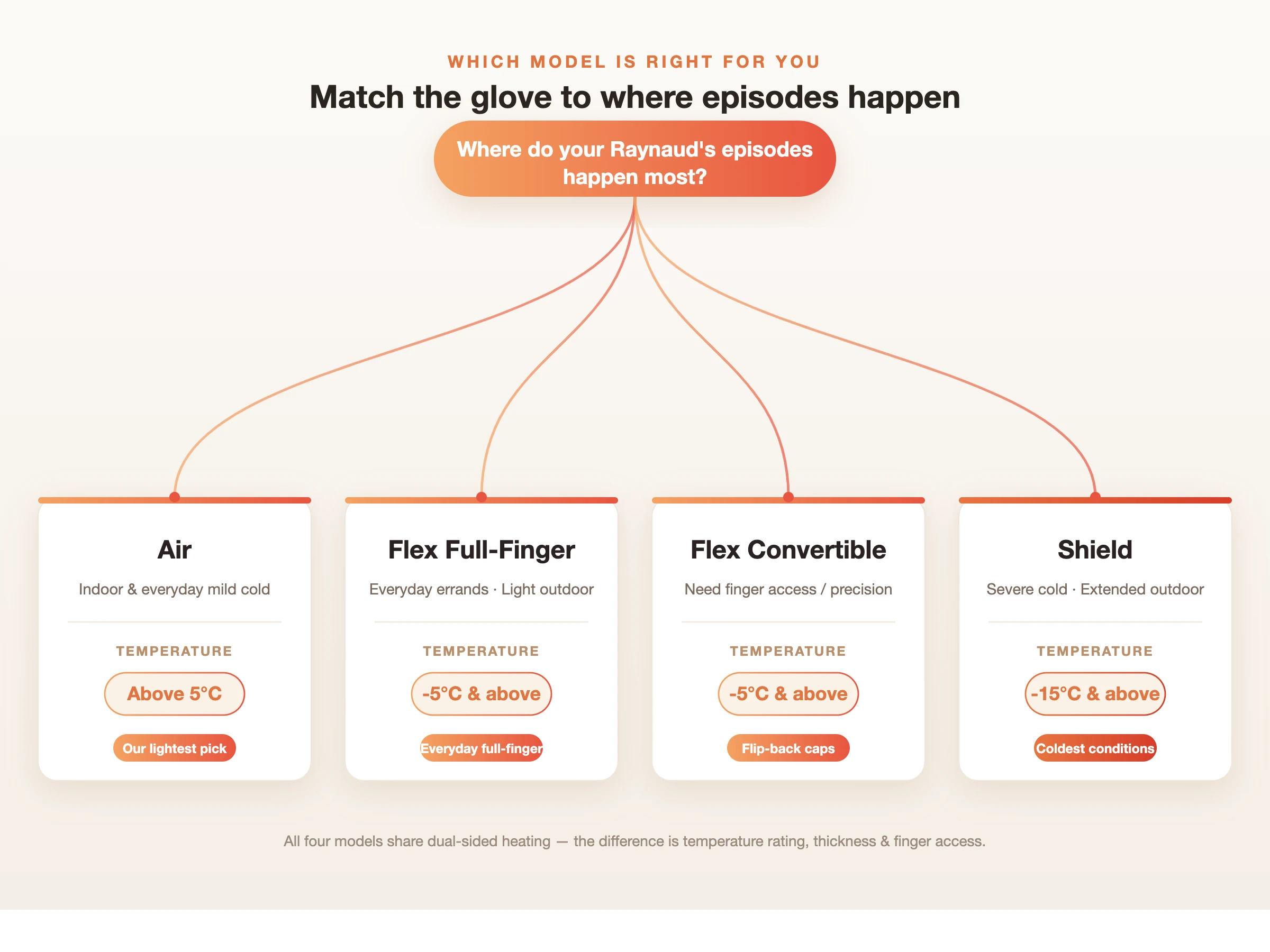
Which Ololar Model Is Right for You?
This is the core decision step. Start with your environment and how much hand
movement you need, then read the model detail below:
- Mostly indoors, mild cold, lots of typing/touchscreen? The Air is the thinnest and most dexterous.
- Everyday errands, some time outside, want full-finger warmth? The Flex Full-Finger is a practical full-finger everyday choice.
- Need to flip open a finger to zip, tap, or handle small objects? The Flex Convertible lets you flip back the thumb and index caps for precision while the palm and back of the hand remain covered by the glove’s active heating system.
- Long time outside in real winter, or sustained exposure to severe cold? The Shield is designed for temperatures of -15°C (5°F) and above and carries the largest battery (3000mAh).
Why These Features Matter for Raynaud’s
Raynaud’s causes episodes where small blood vessels in the fingers narrow, reducing
blood flow and turning the skin white or blue. Cold exposure is the most common
trigger, so keeping the hands warm is an important part of managing cold exposure.
We explain the condition itself through medical sources rather than our own claims:
Mayo Clinic on Raynaud’s,
NHS Raynaud’s, and the
Raynaud’s & Scleroderma Association.
These organizations describe the mechanism and triggers; they are information sources, not endorsements of Ololar.
Three features matter most for Raynaud’s hands:
- Active heating across fingers and hand. Insulation alone does not actively add warmth. Targeted heat on the fingers, palm, and back of hand helps maintain a steadier temperature.
- Adjustable heat levels. Three adjustable heat levels let you choose the level of warmth according to the surrounding conditions and your personal comfort.
- Dexterity without bulk. Raynaud’s does not pause your day. Thin, flexible construction (Air) or flip-open finger caps (Flex Convertible) keep hands usable.
Ololar Air Series — For Everyday Indoor Warmth
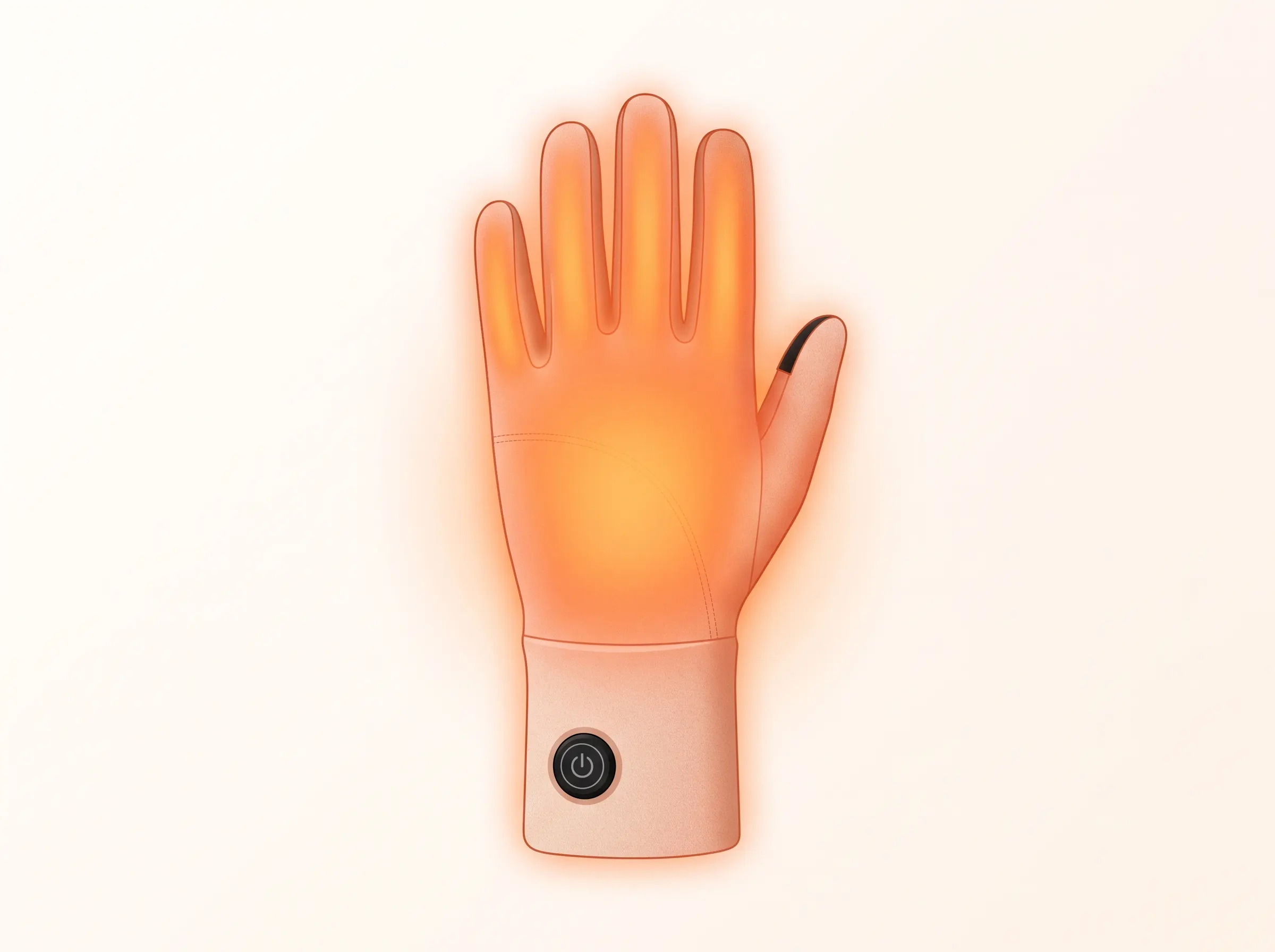
The Air is built for indoor and
mildly cold environments, designed for temperatures above 5°C (41°F). Its
ultra-thin, flexible construction provides dual-sided heating across the palm, back of hand, and fingers, and it is made for desk work, typing, phone and touchscreen
use, and hobbies. If your cold triggers happen mostly at home or in the office, this
is where we start.
Ololar Flex Series Full-Finger — Everyday Warmth With Full Coverage
The Flex Full-Finger
is designed for temperatures at or above -5°C (23°F), for indoor and light
outdoor use — walking, commuting, shopping. Dual-sided heating covers palm, back of
hand, and fingers, with a practical balance of warmth, flexibility, and everyday
comfort. It is the most accessible full-finger option.
Ololar Flex Series Convertible — Warmth With Finger Access
The Flex Convertible shares the
Flex platform (-5°C and above) with dual-sided heating across the palm, back of hand, and fingers, but adds flip-back thumb and index caps, so you can
open a finger for a zipper, card reader, or detailed task while the palm and back of the hand remain covered by the glove’s active heating system. A Lycra outer with a velvet inner keeps it soft and grippy. For
people who need both warmth and hands-on control, this is our pick.
Ololar Shield Series — For Severe Cold and Extended Outdoor Use
The Shield is the cold-weather
model: designed for temperatures of -15°C (5°F) and above, with dual-sided heating across the palm, back of hand, and fingers, for severe cold and
extended outdoor exposure. It carries the largest battery (3000mAh) and prioritizes
dependable warmth over thinness. If you need the most warmth for extended outdoor exposure in severe cold, start here.
Choosing by Scenario
| Scenario | Recommended model | Why |
|---|---|---|
| Indoor (home, mild cold) | Air | Thinnest, most dexterous; designed for above 5°C |
| Office (typing, computer, touchscreen) | Air | Ultra-thin; touchscreen-friendly; keeps hand movement natural |
| Walking / commuting / errands | Flex Full-Finger | Full-finger warmth to -5°C; flexible for everyday use |
| Outdoor (extended, colder) | Flex Convertible or Shield | Convertible for control; Shield for sustained severe cold to -15°C |
| Severe cold (down to -15°C) | Shield | Largest battery (3000mAh); designed for the coldest conditions in the Ololar range |
How Ololar Compares With General-Purpose Heated Gloves
When you search for the “best heated gloves for Raynaud’s,” you’ll also see many general-purpose heated gloves marketed for skiing, commuting, or winter sports. Those products are designed for broad cold-weather recreation. Raynaud’s creates a more specific need — episodes of sudden finger cooling, fingertip sensitivity, and a need for steady, controllable warmth rather than peak heat. That difference shapes how a glove should be built.
| Consideration | Ololar (Raynaud’s-focused) | General-purpose heated gloves |
|---|---|---|
| Finger heating | Heating across the palm, back of hand, and fingers on the Air, Flex, and Shield Series | Often limited to palm or back-of-hand |
| Warmth control | Three adjustable heat settings for steady warmth | Varies; some offer a single fixed level |
| Temperature range | Air above 5°C → Shield down to −15°C | Often a single, narrower range |
| Condition framing | Guidance cites Mayo Clinic, NHS, and the Raynaud’s Association | Rarely condition-specific |
| Scenario fit | Indoor mild use through severe outdoor cold | Typically recreation-focused |
For Raynaud’s specifically, the more useful question is not “which glove is hottest” but “which model keeps your fingers steadily warm across your actual day-to-day life.”
Supporting Articles
Deeper reading from our heated-gloves library:
- What Gloves Are Best for Raynaud’s? — how to think about warmth, coverage, and flexibility.
- How Do Heated Gloves Work? — the heating architecture in plain terms.
- Raynaud’s Glove Features — what to look for beyond heat.
- Are Heated Gloves Good for Indoor Raynaud’s?
- Are Heated Gloves Good for Outdoor Raynaud’s?
- Heated Gloves Safety for Raynaud’s — including Care & Cleaning.
Frequently Asked Questions
Are heated gloves safe for Raynaud’s?
Heated gloves are a warmth tool, not a treatment for Raynaud’s. Use adjustable heat settings, avoid damaged batteries, and follow the care instructions for your specific model. If you have a circulation or skin condition that makes heat exposure a concern, ask a clinician before using heated gloves. See our heated gloves safety guide for model-specific care and cleaning.
Which Ololar model is best for indoor use?
The Air is our pick for indoor
and mildly cold use. It is the thinnest and most dexterous model, designed for
temperatures above 5°C (41°F), and suited to typing, touchscreen use, and
everyday home tasks.
Can I use a touchscreen or keyboard while wearing them?
Yes. The Air is built for
touchscreen and keyboard use, so you can type and tap without removing it. The
Flex Convertible adds
flip-back thumb and index caps, so you can expose a finger for tasks that need
bare-finger precision while the rest of the hand stays heated.
What temperatures are Ololar heated gloves designed for?
Air: above 5°C (41°F). Flex Full-Finger and Flex Convertible: -5°C
(23°F) and above. Shield: -15°C (5°F) and above. Match the model to
where your episodes actually happen.
Do heated gloves cure Raynaud’s?
No. Heated gloves help manage cold sensitivity and support comfort; they do not treat
or cure Raynaud’s. Think of them as a daily-management tool alongside your clinician’s
advice, not a replacement for it.
Which model should I choose if I’m often outside in winter?
Start with the Shield, designed for temperatures of -15°C (5°F) and above and carrying the largest battery (3000mAh). For milder outdoor errands,
the Flex Full-Finger
or Flex Convertible at
-5°C will usually be enough.
Medical note: This article provides general educational information about heated
gloves and Raynaud’s and is not intended to diagnose, treat, or replace professional
medical advice. If you experience frequent, painful, or asymmetric color changes in
your fingers, consult a healthcare professional.