

Short answer: If your hands go cold in an air-conditioned office, start with the simple fixes: get out of the direct airflow, keep an extra layer at your desk, and keep your core warm. Heated gloves can help when those steps are not enough. For desk work, the priorities are thin fabric, finger mobility and heat you can turn down, not maximum heat.
For some people with Raynaud’s, cold hands are not only a winter problem. An air-conditioned room, a cool workspace, cold surfaces or a sudden change in temperature can be enough to make the hands uncomfortable. As explained in Can Raynaud’s Happen Indoors?, being inside does not necessarily remove the cold exposure that can affect temperature-sensitive hands.
This article focuses on one question: when do heated gloves make sense in an office or other air-conditioned space? For the broader picture, see what clinical sources say about heated gloves for Raynaud’s.
What Medical Sources Say About Air Conditioning
Sources saySeveral medical sources mention air conditioning or air-conditioned spaces specifically. The numbers in brackets link to the source list at the end of this article.
“Because air conditioning can cause attacks, set your air conditioner to a warmer temperature.”
Mayo Clinic, Raynaud’s disease: Symptoms and causes
- Mayo Clinic says cold temperatures are the most likely cause of an attack and that air conditioning can also set one off.[1]
- The American College of Rheumatology notes that some people find heavy use of air conditioning a problem.[2]
- NIAMS, part of the U.S. National Institutes of Health, advises bringing a sweater or jacket to indoor settings that may be air-conditioned.[3]
- Scleroderma & Raynaud’s UK advises avoiding sudden temperature changes, such as moving from a hot day into an air-conditioned car, and keeping gloves and an extra layer handy at work.[4]
For a closer look at triggers and what to do about them, see Can Air Conditioning Trigger Raynaud’s?
Cold Hands at the Office: What to Try, in Order
A room can feel comfortable overall while your hands sit in cool air for hours. Work through these steps in order before reaching for anything with a battery.
-
Get out of the direct airflowMayo Clinic suggests setting the air conditioner warmer where you can.[1] If you cannot change the thermostat, ask whether a vent can be redirected or whether you can move your workspace.
-
Keep a thin pair of gloves at your deskScleroderma & Raynaud’s UK suggests keeping gloves and an extra layer at work.[4]
-
Heated gloves, starting on the lowest settingOur viewWorth considering when steps 1 to 4 are not enough, or when you cannot control the room.
-
See a doctor first ifAttacks last hours, color does not return after warming, you get sores on your fingertips, or your hands are numb and you cannot judge heat well.
Whatever you wear while typing, nothing should be tight: Kaiser Permanente warns that clothing that is too tight can reduce blood flow.[6]
When Might Heated Gloves Make Sense in an Office?
Our viewThis section is our view, not guidance from the sources above.
Heated gloves become more relevant when the indoor environment repeatedly makes your hands cold and passive warmth is not enough. This may happen when:
- You spend long periods in a cool or air-conditioned room
- Your hands become cold despite wearing regular gloves
- You frequently move between areas with different temperatures
- Your work requires your hands to stay exposed and free for long periods
- You need a more controllable source of warmth than a passive layer provides
The decision depends less on whether the setting is technically “indoors” and more on whether the environment creates a continuing need for additional warmth. For the specific demands of desk work, Raynaud’s and Office Work explains why the workspace itself can affect hand comfort.
Indoor Use Is Different From Outdoor Use
A glove designed for severe outdoor cold has to deal with wind, prolonged exposure and sometimes precipitation. An indoor glove usually does not face the same demands. For desk work, the priorities are different: enough warmth for the actual room temperature, low bulk, finger mobility, comfort over a long day, and warmth you can adjust.
That is why the warmest glove is not automatically the best indoor option. The broader decision factors are covered in What Type of Heated Gloves Is Best for Raynaud’s?.
What to Look For in Heated Gloves for Desk Work
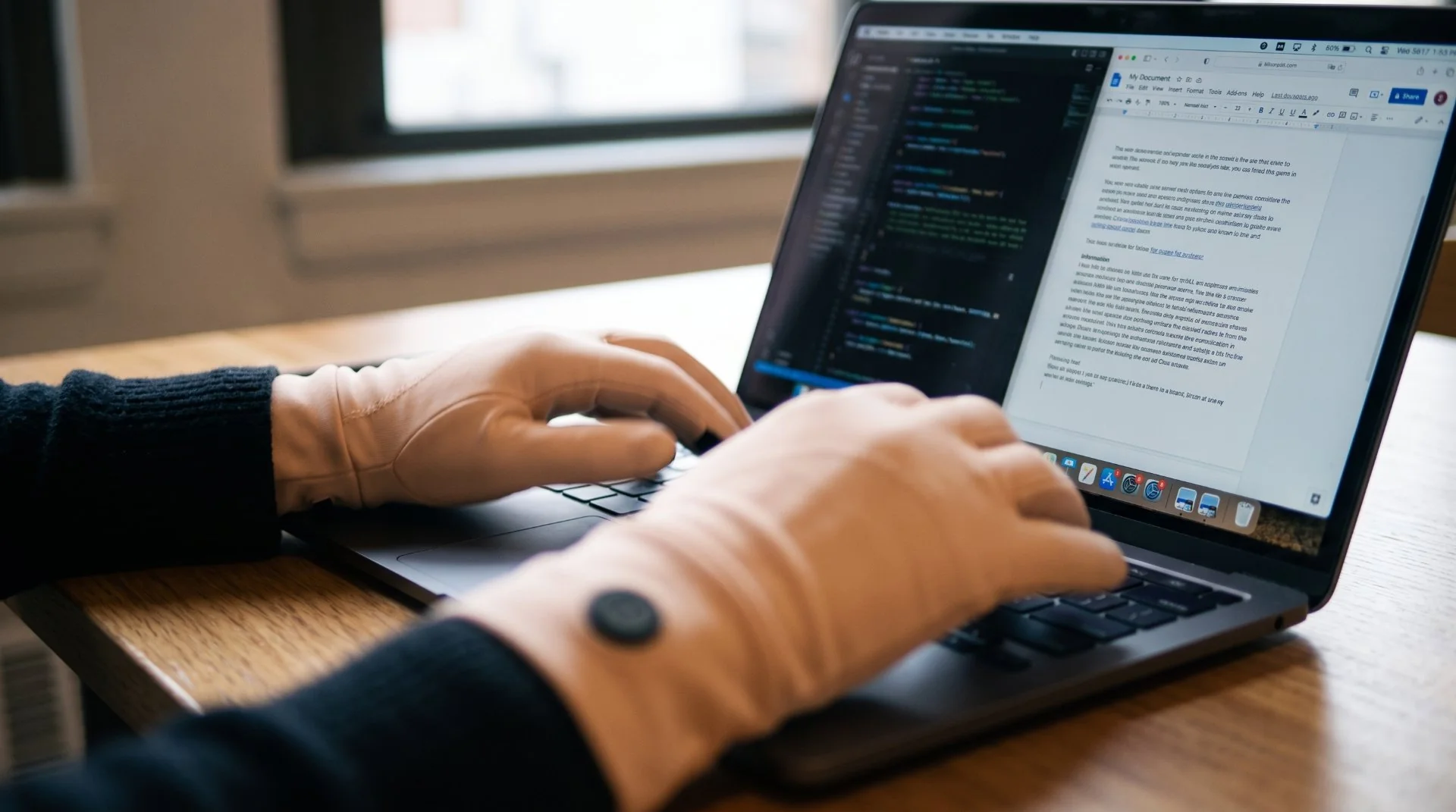
- Thin, flexible fabric. Typing, using a mouse, writing and handling small objects all depend on finger movement, and the Raynaud’s Association lists bulky design and poor dexterity among the drawbacks of heated gloves.[7] For more on keyboard work, see Can You Type While Wearing Heated Gloves?
- Heat that reaches the fingertips. The Raynaud’s Association also calls fingertip heating an important feature and notes that some brands neglect it.[7]
- Adjustable heat. Indoor temperatures change through the day, and lower settings are easier to wear for longer. Look for more than one heat level.
- Touchscreen compatibility. You should not have to take the gloves off to use a phone or tablet. See Raynaud’s and Touchscreens.
- Battery placement and runtime. Check where the battery sits when your forearms rest on a desk, and compare the published runtime with your workday.
- Room to move. Try gloves on with your hand relaxed, and size up if anything presses on your fingers or wrist.
Which Heat Setting Should You Use Indoors?
Indoor temperatures are usually less extreme than winter conditions, so maximum heat is often unnecessary. A sensible approach is to start on the lowest setting and go up only if you need to, using the lowest setting that keeps you comfortable.
If your hands are numb or have reduced sensation, talk to your doctor before using any heated product. In its advice about warm water, Kaiser Permanente warns that numb hands can be burned without feeling it, and the same logic applies to any heat source.[6]
Choosing the Right Size and Heat Level for Indoor Wear
Why fit matters more indoors
Ololar Air comes in S, M, L and XL. Indoors, fit does more work than most people expect. A glove that is too tight presses on the small blood vessels in the fingers, which is the opposite of what you want with Raynaud’s. One that is too loose lets warmth escape and makes typing clumsy. Measure around the widest part of your palm, just below the knuckles, and check the size chart on the Ololar Air product page before ordering. If you fall between two sizes, take the larger one.
Which heat level to use at a desk
Indoor environments rarely call for the highest setting. Start on low and move to medium only if your fingers are still cold after ten minutes. High is meant for colder rooms and shorter periods, not all-day wear — sustained high heat can leave hands clammy, which makes typing harder and feels uncomfortable once you step outside. The Air series is designed for temperatures above 5°C (41°F), so it suits the mild-cold range rather than freezing conditions.
Matching the setting to the situation
| Indoor situation | Suggested heat level | Why |
|---|---|---|
| Typing or desk work in a warm office | Low | Keeps fingers warm without sweat |
| Cold office or strong air conditioning | Medium | Offsets airflow and lower room temperature |
| Moving between indoors and outdoors | Low indoors, medium outdoors | Avoid overheating, adjust on the transition |
If your hands are only cold under air conditioning, a thin glove on low is usually enough. If the same pair has to cover a cold commute as well, check the runtime at each level on the Air product page.
Ololar Air for Office Use
Ololar specificationsAir is the Ololar series designed for indoor use such as typing and writing. Core specifications:
Ololar Air: runtime by heat level
- Thinnest in our range: 0.2 mm fabric, and it can be worn as a liner inside a roomy mitten or glove.
- Three heat levels: Low, Medium and High (green, blue and red switch colors respectively), with the published figures shown above.
- Battery: 7.4 V, 2,200 mAh (16.3 Wh), worn at the wrist.
- Heating elements: carbon-fiber composite elements that follow the contours of each finger, including the thumb and fingertips.
- Touchscreen compatible.
- Recommended ambient temperature: 41°F (5°C) and above, which suits most indoor settings.
See the Ololar Air product page, or compare all three series on our technology page. If you also commute or spend time outdoors, our solutions page shows which series fits which situation.
When Are Regular Gloves Enough?
Heated gloves are not necessary every time someone with Raynaud’s has cold hands indoors. If the room is only mildly cool and a regular glove keeps your hands comfortable, passive insulation is the simpler choice. Environmental changes can also be enough when the source of the cold can be reduced. The key question is whether passive warmth is sufficient for the environment and activity.
Indoor Heated Gloves Are About the Right Balance
There is no universal requirement for heated gloves simply because someone has Raynaud’s. They become more useful when indoor cold, air conditioning or repeated temperature changes continue to make the hands uncomfortable despite simpler measures. The best indoor heated glove is not the one that produces the most heat; it is the one that provides appropriate warmth while letting you keep using your hands comfortably.
Frequently Asked Questions
Are heated gloves good for Raynaud’s in an office?
They can be useful when air conditioning, a cool workspace or temperature changes repeatedly make the hands cold and simpler steps are not enough. Start with moving out of the airflow, an extra layer and thin gloves at your desk. Heated gloves are not a treatment.
Can air conditioning trigger Raynaud’s symptoms?
Yes. Mayo Clinic says cold temperatures are the most likely cause of an attack and that air conditioning can also set one off. The American College of Rheumatology notes that some people find heavy air conditioning a problem. See Can Air Conditioning Trigger Raynaud’s? for more.
What should I try before buying heated gloves?
Get out of the direct airflow, keep an extra layer and a thin pair of gloves at your desk, keep your core warm, and consider chemical hand warmers. NIAMS and Scleroderma & Raynaud’s UK both suggest having a sweater, jacket or gloves on hand.
Do I need heated gloves if my hands are only slightly cold indoors?
Not necessarily. Regular gloves or environmental changes may be enough when the indoor cold is mild.
Should I use the highest heat setting indoors?
Usually not. Start on the lowest setting and go up only if you need to, using the lowest setting that keeps you comfortable. If you have reduced sensation in your hands, talk to your doctor before using any heated product.
Can I type while wearing heated gloves?
It depends on how thin and flexible the gloves are. Ololar Air is the thinnest in our range at 0.2 mm fabric, is designed for indoor use such as typing and writing, and is touchscreen compatible. Try any glove on with your hand relaxed and check that nothing presses on your fingers or wrist. For a closer look, see Can You Type While Wearing Heated Gloves?
What is the best Ololar glove for an office?
Air is our series for indoor use. It has three heat levels, is touchscreen compatible and has a recommended ambient temperature of 41°F (5°C) and above. Flex suits commuting and shopping, and Shield is for extended time in the cold.
How long does the battery last at a desk?
On Air, the published runtime is 6–7 hours on Low, 4–5 hours on Medium and 2–3 hours on High, on a 7.4 V, 2,200 mAh battery. Actual runtime varies with ambient conditions.
Are heated gloves a treatment for Raynaud’s?
No. Heated gloves are a warming tool that can provide additional heat. They are not intended to diagnose, treat, cure or prevent any medical condition.
Sources
- Mayo Clinic, “Raynaud’s disease: Symptoms and causes” (November 16, 2024)
- American College of Rheumatology, “All About Raynaud’s Phenomenon” (patient blog, May 1, 2023)
- NIAMS, “Raynaud’s Phenomenon: Diagnosis, Treatment, and Steps to Take”
- Scleroderma & Raynaud’s UK, “Managing your Raynaud’s symptoms” (last reviewed January 2026)
- Cleveland Clinic, “10 Cold Weather Tips for Managing Raynaud’s During Winter” (January 17, 2024)
- Kaiser Permanente, “Raynaud’s Phenomenon: Care Instructions” (current as of March 10, 2026)
- Raynaud’s Association, post on heated gloves (January 19, 2022)
Sources last checked: October 20, 2026. Apart from the Mayo Clinic quotation above, we paraphrase these pages rather than quote them; follow the links for the full text. Product specifications come from our published product and technology pages.
Medical note: This article provides general information about indoor warmth management and heated gloves for people experiencing Raynaud’s symptoms. Heated gloves are not a treatment or cure for Raynaud’s and should not replace medical evaluation or advice. If symptoms are severe, persistent, changing, or associated with skin damage or other concerning symptoms, seek appropriate medical care.