

Raynaud’s does not follow exactly the same course for everyone. Some people have fairly consistent episodes over the years, while others notice that attacks become more frequent, last longer, or start to feel different.
A single difficult episode does not necessarily mean that Raynaud’s is getting worse. What matters more is whether there is a lasting change in the usual pattern of symptoms, and whether the Raynaud’s is primary or secondary.
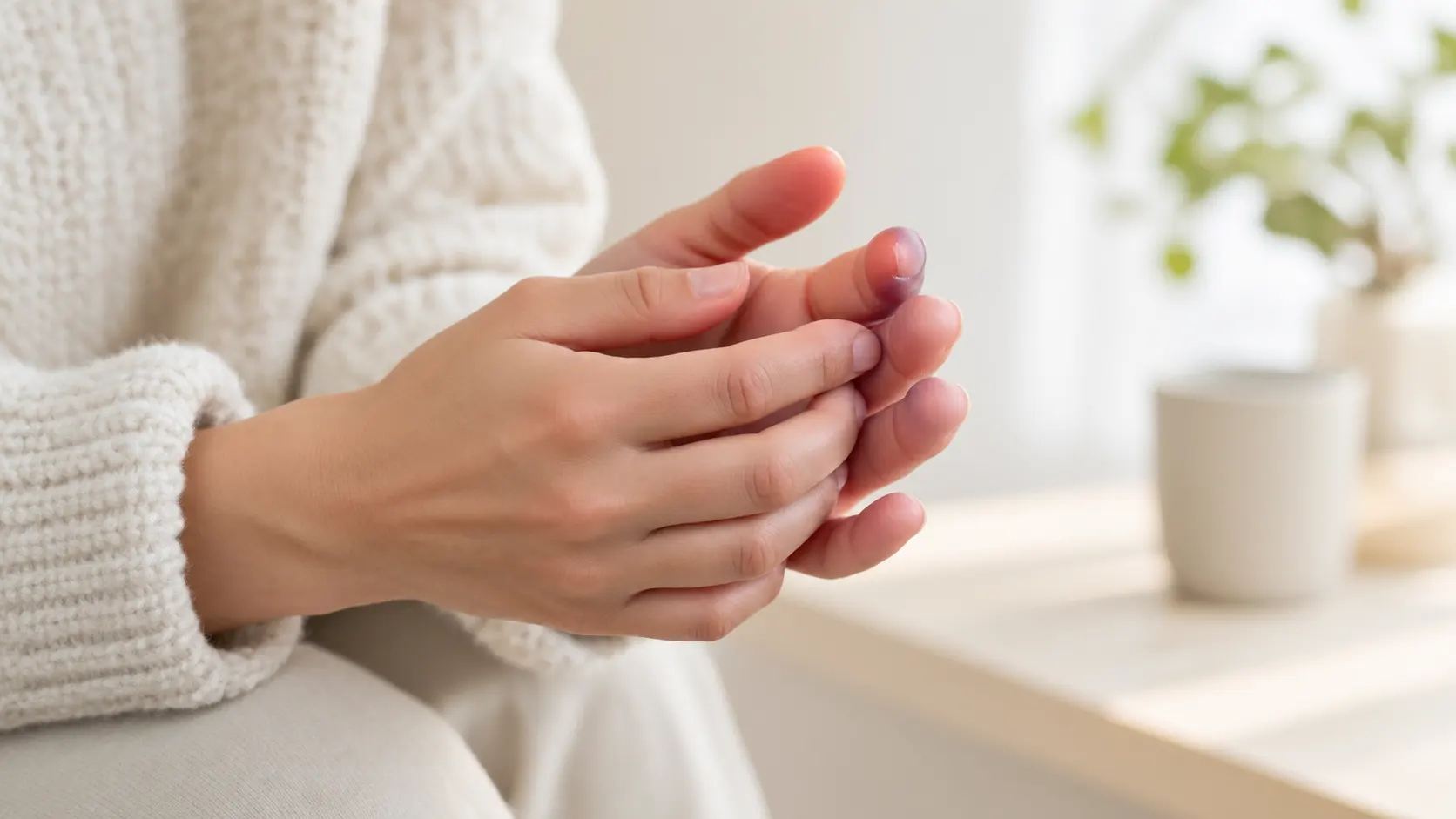
Can Raynaud’s Get Worse Over Time?
Raynaud’s can vary in severity over time, but there is no single pattern that applies to everyone. A period with more noticeable symptoms does not necessarily mean that the condition is progressively worsening.
Cold exposure and stress can make attacks more noticeable or more frequent, for example. At other times, symptoms may remain relatively stable. For this reason, it is more useful to look at the overall pattern than to judge the condition from one particularly uncomfortable attack.
The American College of Rheumatology explains that Raynaud’s can be either primary or secondary, and that more persistent or severe symptoms may require closer medical attention.
Can Primary Raynaud’s Get Worse?
Primary Raynaud’s occurs without an associated underlying condition. It is the more common form and can have periods when symptoms are more noticeable than at other times.
Someone with Primary Raynaud’s may experience more frequent attacks during one period and fewer during another. That change alone does not show that the condition is progressing.
Changes in cold exposure, stress, daily activities, or the environment can also affect when attacks occur. The important question is whether the overall pattern has changed in a sustained or unusual way.
For a clearer explanation of the difference between the two forms, see Primary vs. Secondary Raynaud’s.
Why Does Secondary Raynaud’s Matter?
Secondary Raynaud’s occurs in association with another condition or underlying factor. Because of that connection, a noticeable change in Raynaud’s symptoms can be more significant when it occurs in someone with Secondary Raynaud’s.
A change in symptoms does not identify a particular underlying condition by itself. It simply makes the distinction between Primary and Secondary Raynaud’s more relevant when the usual symptom pattern changes.
What Changes in Raynaud’s Symptoms Are Worth Noticing?
One unusually uncomfortable attack is not necessarily meaningful on its own. A sustained change in the way attacks occur is more useful to pay attention to.
Examples include:
- attacks becoming noticeably more frequent
- episodes lasting longer than they normally do
- symptoms taking longer to settle than usual
- Raynaud’s beginning to interfere more with everyday activities
- symptoms appearing in a pattern that is different from before
- new or persistent changes affecting the skin or tissue of the fingers or toes
None of these changes identifies the reason for the change on its own. They are useful because they show that the person’s usual pattern may have shifted.
Can Longer Raynaud’s Attacks Be a Sign of Something More Serious?
How long an attack lasts can be useful context. Typical Raynaud’s episodes are intermittent and generally improve as the affected area warms.
An unusually long episode does not automatically mean that a serious complication is present. What matters is how different it is from the person’s normal pattern, particularly when symptoms remain persistent or occur alongside other concerning changes.
Can Raynaud’s Cause Tissue Damage?
Most people with Raynaud’s do not develop severe tissue problems. In more severe cases, however, prolonged restriction of blood flow can sometimes lead to tissue damage.
The American College of Rheumatology notes that severe Raynaud’s can cause ulcers on the fingertips or toes when blood flow to the tissue is inadequate.
For that reason, a new sore, ulcer, or other persistent skin change is different from the temporary color changes that can occur during an ordinary Raynaud’s episode.
Does Having More Raynaud’s Attacks Mean Raynaud’s Is Getting Worse?
Not necessarily. Attack frequency can change when exposure to cold, stress, or other triggers changes, so having more attacks does not by itself prove that Raynaud’s is progressing.
A persistent increase in frequency is still worth noticing, especially when it occurs together with longer episodes, symptoms that do not settle as usual, or new physical changes.
If you want to understand attack frequency in more detail, see How Often Do Raynaud’s Attacks Happen?.
When Should You Talk to a Doctor About Changes in Raynaud’s?
Medical assessment may be appropriate when Raynaud’s becomes unusually severe, keeps getting worse, starts interfering with daily life, or develops a pattern that is clearly different from before.
A change in symptoms does not necessarily mean that a serious underlying problem is present. Medical assessment can help put the change in context instead of assuming that it is simply part of the usual course of Raynaud’s.
For a more focused discussion of when medical evaluation may be appropriate, see When Should You See a Doctor About Raynaud’s?.
Can Raynaud’s Get Worse Over Time? The Short Answer
Raynaud’s can vary in severity over time, but a change in symptoms does not automatically mean that it is progressively getting worse. The distinction between Primary and Secondary Raynaud’s matters, and changes such as more persistent symptoms, unusually long attacks, worsening patterns, or signs of tissue damage deserve particular attention.
Frequently Asked Questions
Can Raynaud’s get worse over time?
Raynaud’s can vary in severity over time, but changes in symptoms do not necessarily mean that the condition is progressively worsening.
Does Primary Raynaud’s get worse?
Primary Raynaud’s can have periods of more noticeable or frequent symptoms, but changes in symptoms alone do not establish that the condition is progressing.
Is Secondary Raynaud’s more concerning?
Secondary Raynaud’s is associated with another underlying condition or factor, so noticeable changes in symptoms may warrant closer medical attention.
Can Raynaud’s attacks become more frequent?
Yes. Attack frequency can change over time, but more frequent attacks alone do not prove that Raynaud’s is progressively worsening.
Can longer Raynaud’s attacks be a warning sign?
More persistent or unusually long symptoms are different from a person’s typical short-lived episodes and may warrant medical assessment, particularly when they represent a clear change from the usual pattern.
Can Raynaud’s cause tissue damage?
Severe Raynaud’s can sometimes cause tissue damage, including ulcers on the fingertips or toes, when blood flow remains significantly restricted.
When should I see a doctor if my Raynaud’s is getting worse?
Consider medical advice if symptoms become unusually severe, continue getting worse, affect daily life, remain persistent, or are accompanied by new skin or tissue changes.
Medical note: This article provides general educational information about Raynaud’s and changes in symptom severity and is not intended to diagnose, treat, or replace professional medical advice. Changes in symptoms or signs of tissue damage should be evaluated by a qualified healthcare professional.