

If you have Raynaud’s, keeping your hands warm is important, but warmth does not start and end with the hands. When the body is exposed to cold, it constricts blood vessels in the skin and extremities to reduce heat loss and help maintain core temperature. In people with Raynaud’s, peripheral blood-vessel constriction can be more pronounced, making overall cold exposure worth considering.
This does not mean that raising your core temperature is itself a treatment. A more accurate way to understand it is that keeping the whole body warm can reduce overall cold exposure, while hand protection directly helps protect the areas where Raynaud’s symptoms commonly occur.
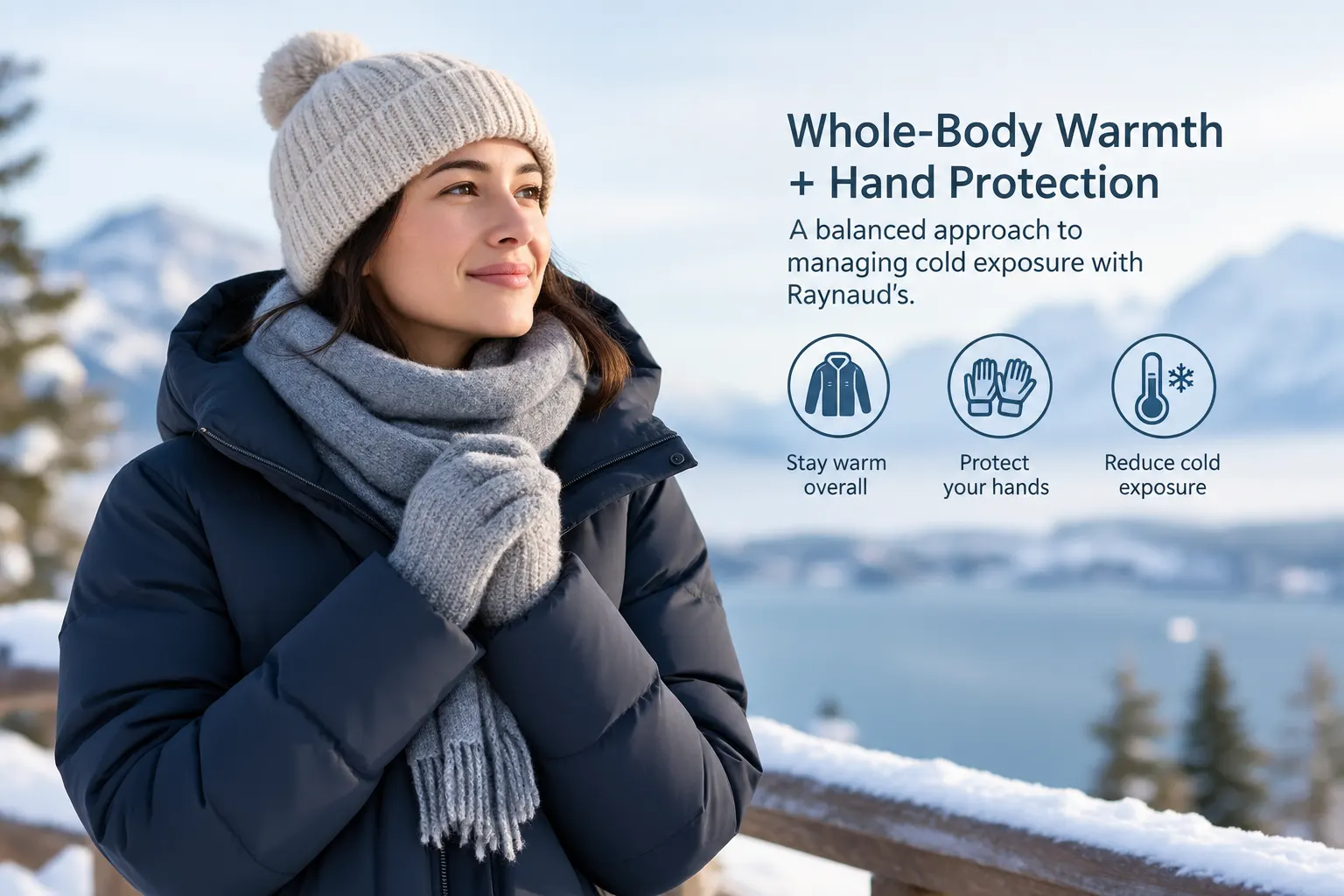
Why Does Whole-Body Warmth Matter for Raynaud’s?
The body responds to cold by adjusting blood flow to the skin and extremities. Blood vessels near the skin constrict, which reduces heat loss and helps the body conserve heat for its core. This normal response to cold is described in research on cold-induced peripheral vasoconstriction and human thermoregulation.
For people with Raynaud’s, the blood vessels in the fingers can respond more strongly to cold and other triggers. This can cause a noticeable reduction in blood flow to the fingers, followed by symptoms such as coldness, numbness, tingling, or changes in skin color.
This connection is important because the hands are part of the body’s overall response to cold. Keeping the hands warm is therefore only one part of reducing cold exposure.
Does Keeping Your Core Warm Actually Help Raynaud’s?
Keeping the whole body warm can help reduce overall exposure to cold, and clinical guidance for Raynaud’s commonly recommends staying warm rather than focusing only on the hands.
The American College of Rheumatology’s guidance on Raynaud’s Phenomenon recommends keeping the whole body warm and wearing warm, protective clothing when exposed to cold. NHS patient guidance on Raynaud’s also emphasizes keeping the whole body warm, particularly the hands and feet.
However, this should not be interpreted as evidence that increasing core temperature directly prevents Raynaud’s attacks. The more accurate conclusion is that whole-body warmth can be part of managing cold exposure, while direct hand protection remains important for the fingers themselves.
Why Can Cold Affect the Hands Even When the Main Goal Is to Protect the Core?
One of the body’s normal responses to cold is to reduce blood flow to peripheral areas. This helps limit heat loss from the skin and extremities, allowing the body to conserve heat.
That response can leave the fingers colder than the rest of the body. In Raynaud’s, the peripheral vascular response can be particularly pronounced, so the difference between overall body warmth and finger warmth can be noticeable.
This is why someone can feel reasonably warm overall while still experiencing very cold fingers.
Why Might Warming Only the Hands Not Be Enough?
Gloves can directly protect the hands from cold air and other environmental exposure, but they do not change the temperature conditions affecting the rest of the body.
If the body remains exposed to cold for an extended period, overall cold exposure continues even when the hands are well protected. Whole-body warmth and hand protection therefore address different parts of the same situation.
For practical ways to keep the hands warm, see How to Keep Your Hands Warm With Raynaud’s.
Why Can Your Fingers Still Feel Cold When Your Body Feels Warm?
Core temperature and finger temperature are not the same thing. The body can maintain a relatively stable core temperature while reducing blood flow to peripheral areas in response to cold.
Raynaud’s can make this peripheral response more noticeable. As a result, feeling warm in the torso does not necessarily mean that the fingers will also feel warm.
This distinction is useful when thinking about cold protection: keeping the body warm does not eliminate the need to protect the hands directly.
Why Do Temperature Changes Matter?
Raynaud’s symptoms can be associated with changes in temperature, not only with prolonged exposure to very cold conditions.
Moving from a warm environment into cold outdoor air, handling cold water, or spending time in a strongly air-conditioned space can expose the hands to a sudden change in temperature.
Reducing unnecessary cold exposure and maintaining warmth before entering a colder environment can therefore be useful. For more about temperature changes and Raynaud’s, see How to Manage Raynaud’s During Temperature Changes.
What Does Keeping Your Core Warm Actually Mean?
Core warmth does not mean keeping the body unusually hot or simply wearing as many layers as possible.
The practical goal is to reduce overall exposure to cold and maintain a comfortable thermal environment. The amount of protection needed depends on factors such as the environment, activity level, duration of exposure, and individual sensitivity to cold.
Core warmth is therefore best understood as part of an overall approach to managing cold exposure with Raynaud’s, rather than as a standalone treatment.
Should Core Warmth and Hand Warmth Be Considered Together?
Yes. They address different aspects of cold exposure and can be considered together.
- Whole-body warmth: helps reduce overall exposure to cold.
- Hand protection: directly protects the fingers and hands from the surrounding environment.
- Environmental management: helps reduce sudden temperature changes and unnecessary cold exposure.
These measures do not need to replace one another. The appropriate balance depends on the environment and activity.
For more about choosing hand protection, see What Gloves Are Best for Raynaud’s?.
Can Keeping Your Core Warm Prevent Raynaud’s Attacks?
It cannot be guaranteed.
Keeping the whole body warm is commonly included in everyday cold-management advice for people with Raynaud’s, but attacks can still occur in response to cold, temperature changes, stress, and other individual triggers.
The value of core warmth is therefore better understood as reducing overall cold exposure rather than preventing or treating Raynaud’s attacks.
Does Keeping Your Core Warm Help Raynaud’s? The Short Answer
Keeping your whole body warm can be useful as part of managing cold exposure with Raynaud’s, but it does not replace direct hand protection or guarantee prevention of an attack. Cold causes peripheral blood vessels to constrict as part of normal heat regulation, while people with Raynaud’s may have a more pronounced response in the fingers. For this reason, staying warm is best approached as a whole-body and hand-protection strategy rather than focusing on the hands alone.
Frequently Asked Questions
Does keeping your core warm help Raynaud’s?
It can help reduce overall exposure to cold and is part of common cold-management advice for Raynaud’s. However, it does not replace direct hand protection or guarantee prevention of an attack.
Why can my fingers feel cold when the rest of my body feels warm?
The body can maintain core temperature while reducing blood flow to peripheral areas during cold exposure. This response can be more pronounced in people with Raynaud’s.
Is warming only the hands enough for Raynaud’s?
Not necessarily. Hand protection directly protects the fingers, but the rest of the body may still be exposed to cold. Whole-body warmth and hand protection can therefore be considered together.
Can keeping your core warm prevent Raynaud’s attacks?
It cannot be guaranteed. Whole-body warmth can reduce overall cold exposure, but Raynaud’s may still be triggered by cold, temperature changes, stress, and other individual factors.
Why is whole-body warmth relevant to Raynaud’s?
The body uses peripheral blood-vessel constriction to reduce heat loss during cold exposure, while this response can be more pronounced in Raynaud’s. This is why staying warm should not focus only on the hands.
Sources
Medical note: This article provides general educational information about whole-body warmth and Raynaud’s and is not intended to diagnose, treat, or replace professional medical advice.