

Raynaud’s is commonly associated with cold, but temperature is not the only possible trigger. Emotional stress can also contribute to an attack, which means some people may notice their fingers becoming cold, numb, or changing color during stressful situations even when the surrounding temperature has not changed.
The connection is related to how blood vessels respond during stress. Understanding this can help explain why Raynaud’s symptoms sometimes appear in situations that do not seem obviously cold.
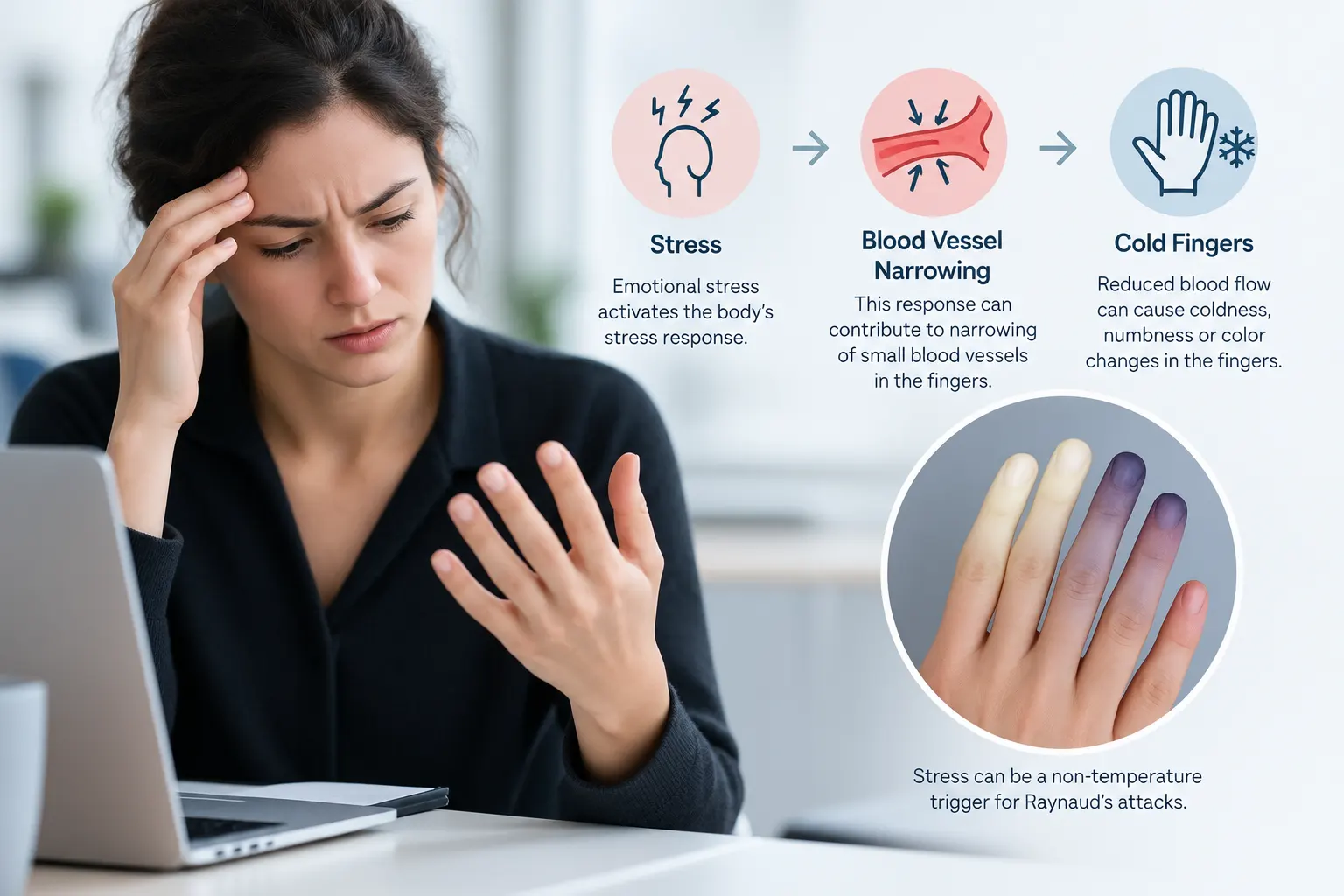
How Stress Can Trigger Raynaud’s Attacks
Yes. Emotional stress can trigger or worsen Raynaud’s symptoms in some people.
During an episode, the small blood vessels supplying the fingers can narrow and reduce blood flow. Raynaud’s blood vessels can react strongly to both cold and stress, so an emotional or stressful situation may contribute to the same type of vascular response that occurs during cold exposure.
This does not mean that stress causes Raynaud’s itself. Rather, stress can act as a trigger for symptoms in someone who already experiences Raynaud’s episodes.
How Can Stress Affect Raynaud’s Symptoms?
Stress activates the body’s normal response to a perceived threat. This response can affect the cardiovascular system and blood vessels, including changes that can contribute to narrowing of blood vessels.
For someone with Raynaud’s, this vascular response can be enough to trigger an episode. The fingers may become colder or numb, and some people may notice the same color changes that occur during other Raynaud’s attacks.
The response is not identical for everyone. Some people may notice a clear connection between stressful situations and their symptoms, while others may experience Raynaud’s mainly in response to cold.
Why Can Raynaud’s Happen During Stress Even When It Is Not Cold?
Raynaud’s does not require direct cold exposure every time an episode occurs.
Cold is a common trigger because it causes blood vessels in the extremities to narrow. Emotional stress can also influence vascular responses, providing another pathway through which an attack may occur.
This is why someone might notice cold or numb fingers during an argument, an important presentation, an examination, or another stressful situation even while indoors.
Stress is one of several possible Raynaud’s triggers. Cold, temperature changes, and other triggers are discussed in What Triggers Raynaud’s Attacks?.
Does Stress Affect Everyone With Raynaud’s?
No. Raynaud’s triggers vary from person to person.
Some people may notice that cold air is their main trigger, while others may react to sudden temperature changes, emotional stress, or a combination of factors.
It can be useful to pay attention to the circumstances surrounding an episode rather than assuming that every attack has the same cause. If symptoms repeatedly appear during stressful situations, that pattern may be worth noting.
What Might a Stress-Triggered Raynaud’s Episode Feel Like?
A stress-related episode can involve symptoms similar to those triggered by cold.
- Fingers may suddenly feel cold.
- The fingers may become numb or have a tingling sensation.
- Skin color may change in the affected fingers.
- Symptoms may improve as the triggering situation passes and blood flow returns.
Not everyone experiences the same combination of symptoms, and visible color changes may not always be obvious.
Can Stress Make Existing Raynaud’s Symptoms Feel Worse?
It can. Stress may act as a trigger for an attack or contribute to symptoms that are already developing.
For example, a person may already be exposed to a mildly cold environment and then experience additional stress. The combination of environmental and emotional factors may make an episode more noticeable.
This is one reason why identifying personal triggers can be more useful than looking for a single universal cause.
What Should You Do If Stress Seems to Trigger Raynaud’s?
The first step is to recognize the pattern without assuming that stress is the only cause.
If an episode occurs during a stressful situation, moving away from cold exposure and keeping the hands comfortably warm may help reduce additional cold exposure. It can also be useful to notice whether similar episodes happen repeatedly in comparable situations.
Stress management may be relevant when stress is a recurring trigger, but this article is focused on the relationship between stress and Raynaud’s rather than general stress-management techniques.
For broader strategies for keeping Raynaud’s hands warm in everyday life, see How to Keep Your Hands Warm With Raynaud’s.
When Should Stress-Related Symptoms Be Taken Seriously?
Stress can be a trigger for Raynaud’s, but not every episode of cold, numb, or discolored fingers should automatically be attributed to stress.
New, unusually severe, persistent, or changing symptoms may have other causes and may require medical evaluation. Symptoms that occur without an obvious trigger or are accompanied by significant skin changes should also not simply be assumed to be a normal stress response.
The purpose of identifying stress as a possible trigger is to understand a pattern of Raynaud’s symptoms, not to use stress as an explanation for every unusual hand symptom.
Can Stress Trigger Raynaud’s? The Short Answer
Yes. Emotional stress can trigger or worsen Raynaud’s symptoms in some people. Stress can contribute to changes in vascular response, and the small blood vessels in the fingers may narrow enough to produce coldness, numbness, tingling, or color changes. Stress is one possible trigger, alongside cold and temperature changes, and not everyone with Raynaud’s responds to stress in the same way.
Frequently Asked Questions
Why Can Stress Bring on a Raynaud’s Attack?
Yes. Emotional stress can trigger or worsen Raynaud’s symptoms in some people by contributing to the vascular response that narrows small blood vessels.
Can Raynaud’s happen when it is not cold?
Yes. Emotional stress can be a trigger, so some people may experience Raynaud’s symptoms even without obvious cold exposure.
Why do my fingers get cold when I am stressed?
Stress can affect vascular responses, and people with Raynaud’s may have an exaggerated narrowing of the small blood vessels in the fingers during stressful situations.
Does stress make Raynaud’s worse?
Stress can trigger or worsen symptoms in some people, although individual Raynaud’s triggers vary.
Is stress the only trigger for Raynaud’s?
No. Cold, sudden temperature changes, and other factors can also trigger Raynaud’s. Stress is one possible non-temperature trigger.
Medical note: This article provides general educational information about stress and Raynaud’s and is not intended to diagnose, treat, or replace professional medical advice.